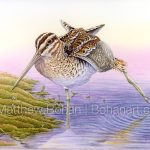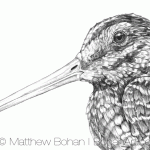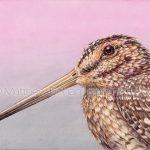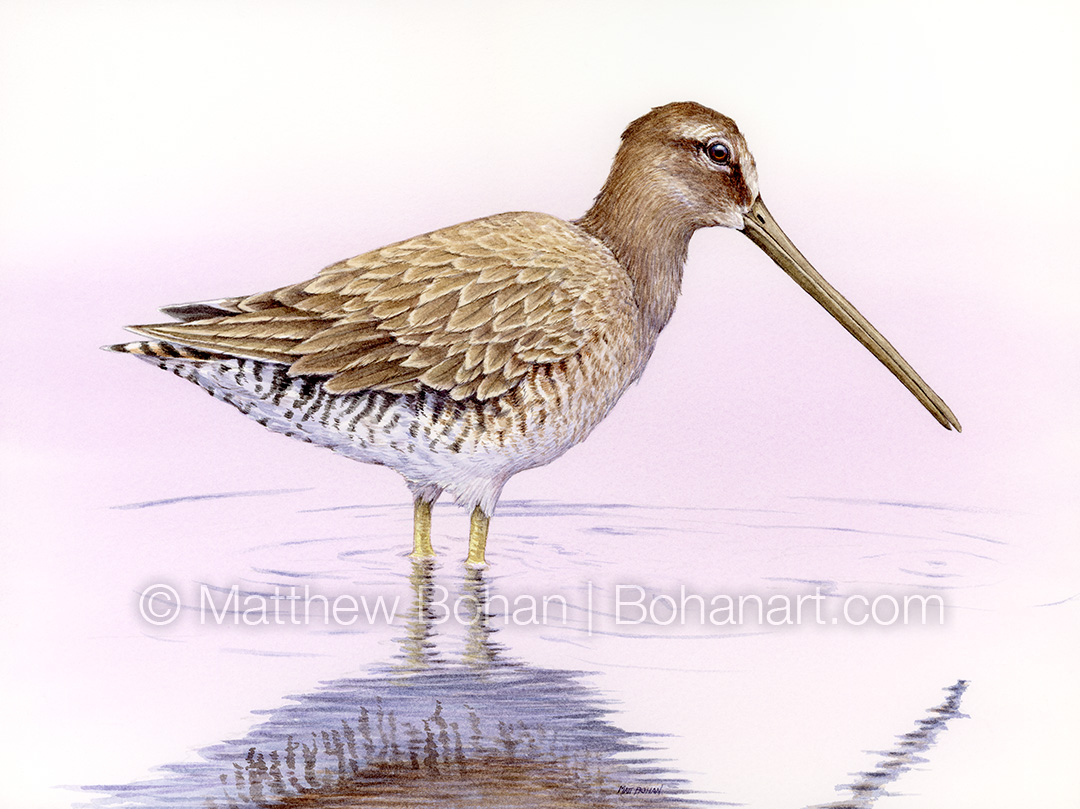
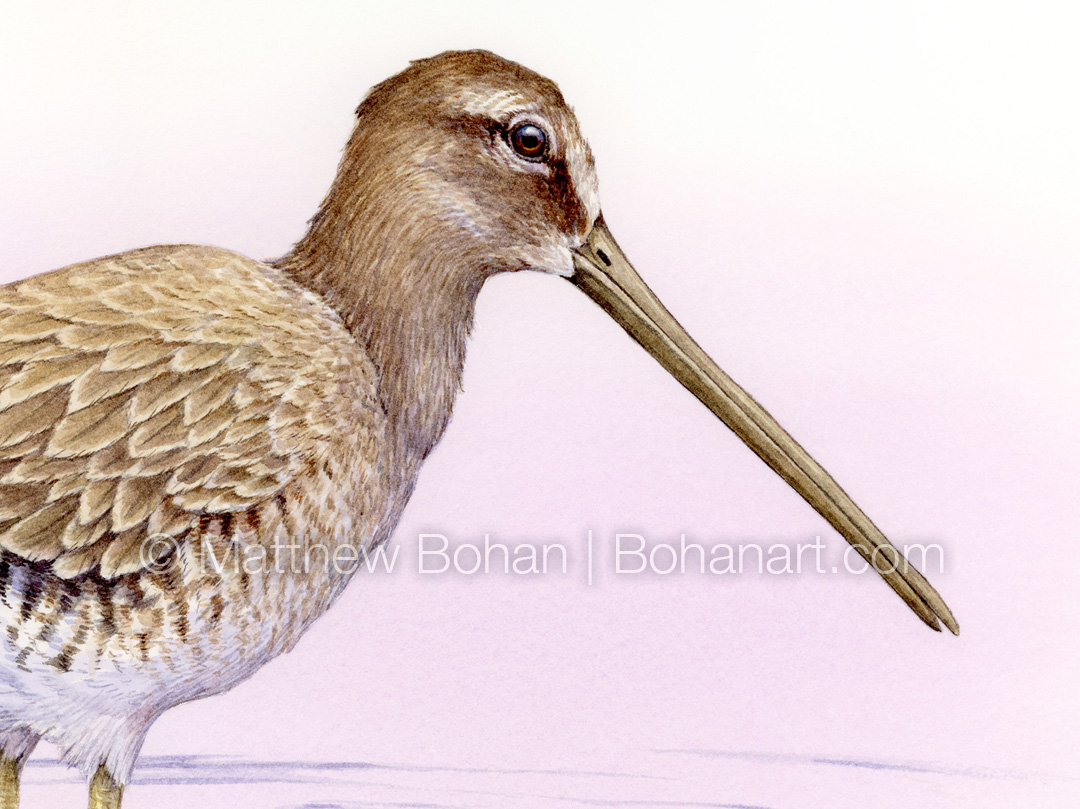
Two shorebirds in a row! That seldom happens for me. I guess it’s less unusual after getting a ton of photos from a trip to Florida this winter. The photos I used for this painting of a winter-plumed Long-billed Dowitcher were taken a few feet away from the ones I used for my recent Wilson’s Snipe painting. It was a super-foggy morning, which made for some interesting photos.
My previous snipe painting was a bit of a pain. I wanted to get right back on the horse and see if I could learn from that experience. The background on this one was super simple. I wanted a really light background. On this one I used a light wash of pink with a hint of purple. I almost never work on white backgrounds. Even a slight suggestion of color seems to be more interesting than white. In a quick look back in my archives, I did only one painting with a partially white background over the past 5 years.
So, why pink? Completely white would have been the most literal to what i saw, but I avoid white because I find it boring, and the art tends to look like a spot illustration. Gray would be the next most obvious, but for me it also seemed lifeless. Blue would’ve read as a more watery or reflected sky, as you might see more mid-day. I thought the blue would suck the life out of the warm tones of the bird. I went with the pinkish color because it would add a sunrise feel, while working well with the warmish colors on the bird. Those pinks could easily be pushed purple-blue for shadows, which would all provide a lot more color to play with over neutral grays.
Another way that this one was a little different for me is that the composition was so straightforward. Normally, I like have a bit more going on in the frame to keep the eye moving around and to offer several areas of interest. One of the fun things I recall about taking photos of this bird is that I was thinking of how neat it was that the bird and I were kind of quietly watching each other. For this painting, I thought it was more about trying to capture that placid moment, so compositionally less might be more—allowing the viewer to soak in the simple scene and gaze into the bird’s eye.