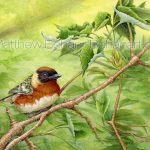
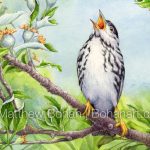
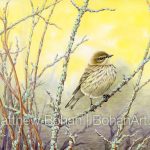
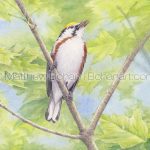
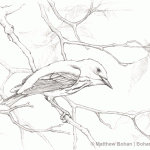
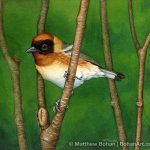
Warblers are one of my favorite birds to paint. I’ve painted Bay-breasted Warblers before, but only in their spring plumage. Many warblers become incredibly drab in the fall, which makes identification tricky. In central Michigan, two species can be especially hard to tell apart: the Bay-breasted Warbler and the Blackpoll Warbler. They look nothing alike in the spring, but in the fall… that’s another story. Fall Bay-breasted Warblers tend to have less streaking, sometimes retain a bit of light bay coloration on the sides, and lack the yellow feet that help identify Blackpoll Warblers. In the field, I can’t always tell them apart myself—especially at a distance or silhouetted against a white sky—so I often just call them “Baypoll Wablers.”
Many birders don’t spend a lot of time birding in the fall because the IDs can be so difficult. I learned a ton by visiting MSU Banding Station, where the staff generously show birds in hand and describe the best ways to distinguish confusing fall warblers apart. One of the reasons I love fall birding is that the number of birds increases dramatically compared to spring, thanks to a surge of young birds and fewer losses from migration. Plus it’s kind of fun to learn and test new ID skills. Sometimes it’s almost like getting to see a whole new bird. A great example is the Chestnut-sided Warbler: in the fall it sports a gorgeous greenish head with a cute eye ring, totally different from its spring plumage. I really need to paint one of those soon!