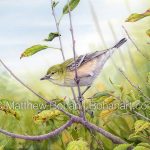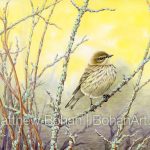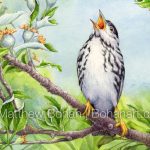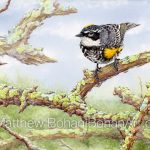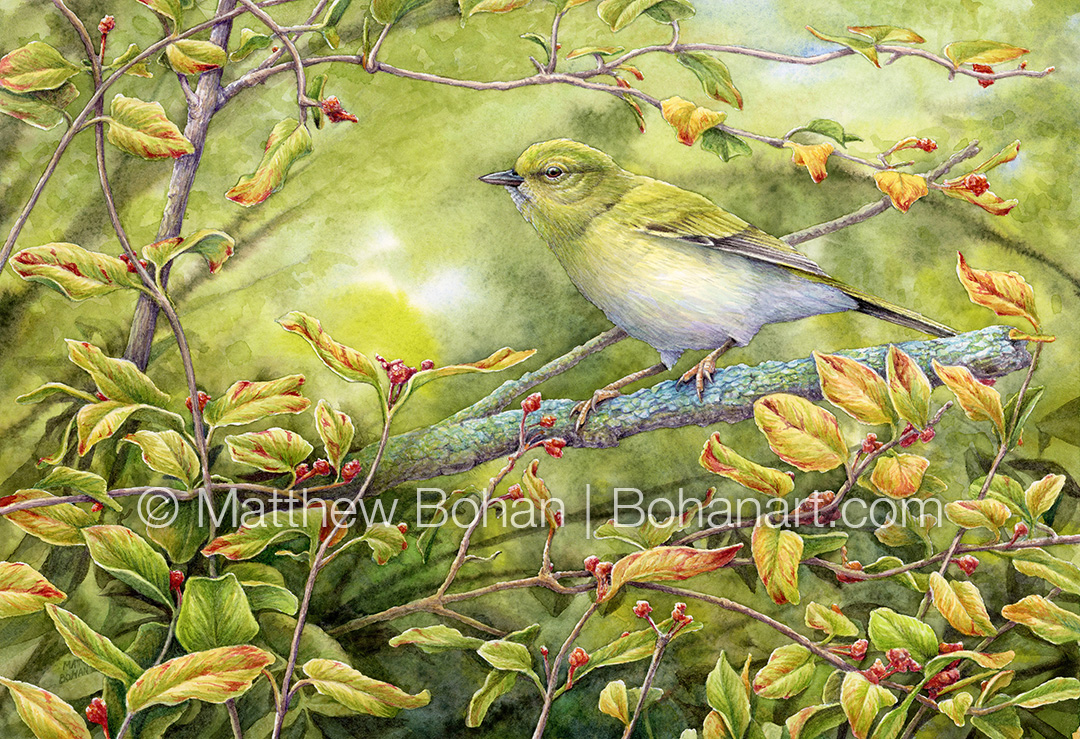
Despite them being relatively common in migration, it took me a while to get around to painting a Tennessee Warbler. These birds breed in Canada and pass through our yard here in Michigan for just a few weeks in the fall and spring.
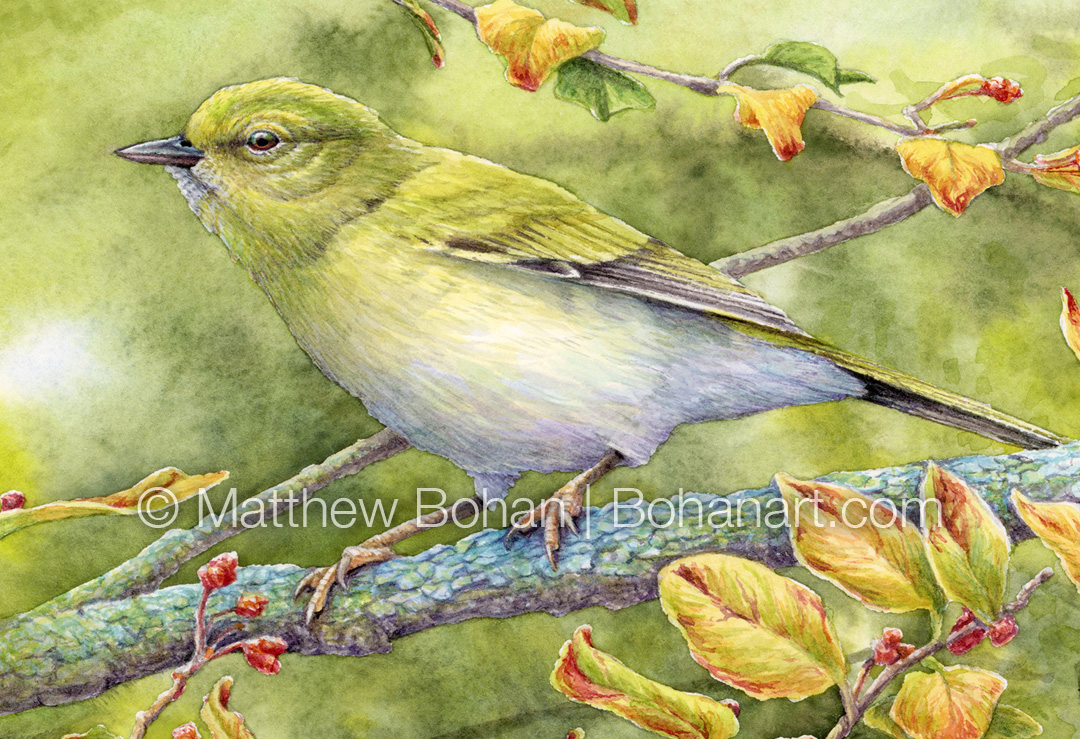
I usually think of their feet and legs being on the gray side, but in my reference photos they definitely show some pinkish to yellow tones. When looking at more references, I found quite a bit of variation. I could see myself tweaking the color later, but I’ve called it finished for now.
It is amazing how well camouflaged these birds are, despite having so much bold color on them. In paintings, there is always a compromise between showing off a bird and having it look like it blends in with its environment. I often find myself manipulating backgrounds to help the birds pop out a bit. This might mean adding contrast to a particular area, simplifying the background behind the bird, or showing a break in the greenery to allow the sky to show through and set it apart. Every painting seems to require a different solution.
My wife is from Tennessee. Despite having visited the state countless times, I’ve never seen a Tennessee Warbler there. They only fly through the state and don’t stay to breed, and we have never been there during migration. It’s a classic example—much like the Cape May Warbler—of a bird named for where it was first described rather than where it lives. In this case, Alexander Wilson found a specimen while it was migrating through Tennessee in 1811. Normally they breed in the boreal forests of Canada and overwinter in Central and northern South America.